
Pizza Informer recipe
Homemade Pizza Sauce: Uncooked or Cooked
Published January 31, 2023Last updated August 7, 2026
Make a bright uncooked pizza sauce or a thicker simmered sauce from one can of whole peeled tomatoes. The recipe includes precise seasoning, consistency cues, pizza portions, substitutions, storage, freezing, and troubleshooting.
Jump to recipe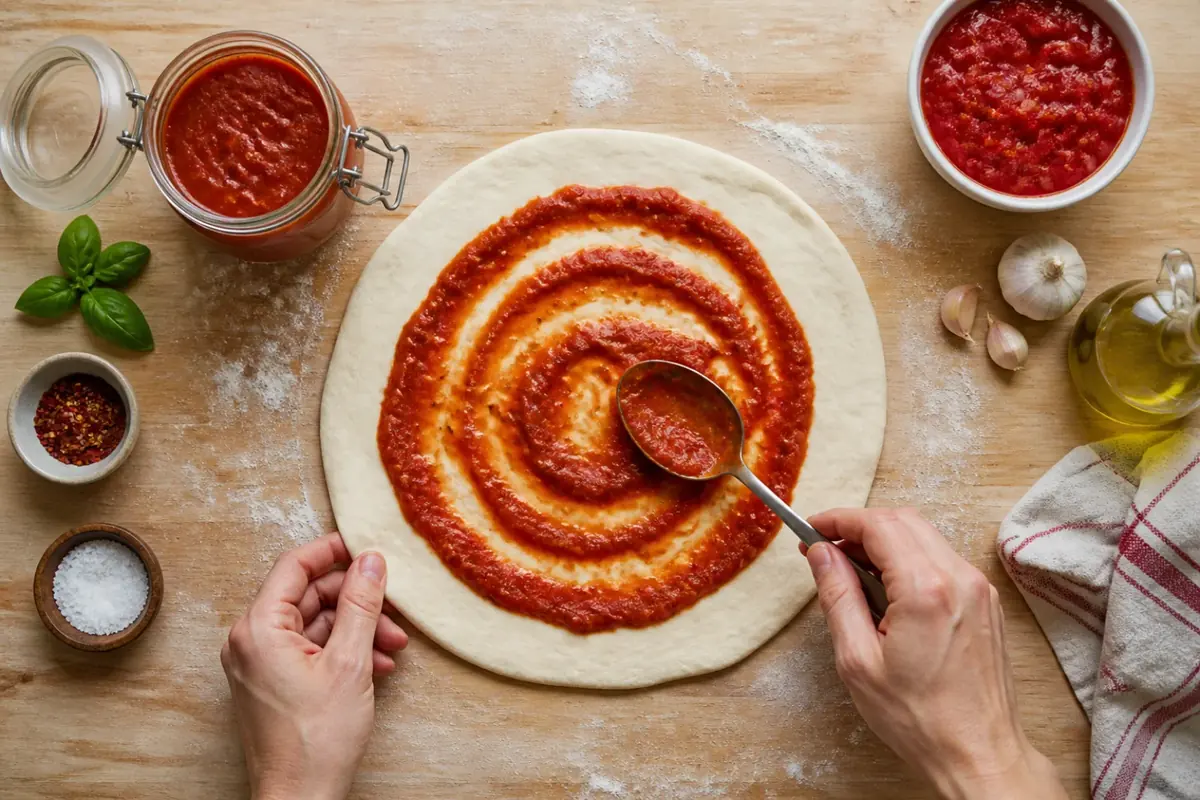
A useful pizza sauce should taste clearly of tomato and spread without flooding the dough. This recipe starts with one 28-ounce can of whole peeled tomatoes and gives you two paths: an uncooked sauce with a fresh, direct flavor, or a gently simmered sauce that is thicker, rounder, and better suited to longer bakes or topping-heavy pizzas.
The uncooked version takes about 15 minutes and works especially well on pizza baked quickly at high heat. The tomatoes cook on the pizza, preserving more of their brightness. The cooked version simmers for 20 to 30 minutes, removing water and concentrating the tomatoes before they reach the dough.
Neither method requires a blender. Crushing the tomatoes by hand or pulsing them briefly leaves enough texture to keep the sauce from becoming foamy or watery. Season lightly at first, particularly if the canned tomatoes contain added salt; you can always add more after tasting.
The recipe
Homemade Pizza Sauce: Uncooked or Cooked
Tomato sauce base
- 1 can (28 ounces or 794 grams) whole peeled tomatoes, preferably packed in juice rather than thick puree
- 1 tablespoon extra-virgin olive oil, divided if making the cooked variation
- ¾ teaspoon fine sea salt, plus more only after tasting
- ½ teaspoon dried oregano, crushed between your fingers
- 1 small garlic clove, finely grated or minced, optional
- 6 fresh basil leaves, torn, optional
- Up to ½ teaspoon granulated sugar, only if the finished sauce tastes unpleasantly sharp
Method
- Drain the tomatoes without discarding the juice. Place a colander over a bowl and pour in the tomatoes. Let them drain for 3 to 5 minutes, then reserve the collected juice. This short draining period removes excess liquid without leaving the tomatoes dry. If they are packed in a very thick puree rather than juice, skip the colander and transfer everything to a bowl.
- Crush the tomatoes. Remove any firm stem ends or stray pieces of skin. Crush the tomatoes with clean hands until no piece is larger than about ½ inch. For a smoother sauce, use an immersion blender for two or three short pulses or pulse the tomatoes in a food processor five to eight times. Stop before the mixture becomes pale or foamy.
- Finish the uncooked sauce. For uncooked sauce, stir the full tablespoon of olive oil, salt, oregano, and optional grated garlic into the crushed tomatoes. Let the sauce stand for 10 minutes, then taste it. Add more salt by the pinch if needed. If it is thicker than a loose marinara, stir in reserved tomato juice 1 tablespoon at a time. Add the torn basil immediately before assembling the pizzas so it does not darken during storage.
- Or make the cooked variation. For cooked sauce, place a medium saucepan over medium-low heat. Add 1 teaspoon of the measured olive oil and the optional garlic. Cook for 30 to 45 seconds, stirring constantly, just until the garlic smells fragrant; do not let it brown. Carefully add the crushed tomatoes, then stir in the remaining olive oil, salt, and oregano.
- Simmer until spreadable. Bring the sauce to a gentle simmer, then reduce the heat to low. Cook uncovered for 20 to 30 minutes, stirring every few minutes and scraping the bottom of the pan. The finished sauce should mound briefly on a spoon but still spread easily. A spoon dragged across the bottom of the pan should leave a trail that closes slowly rather than filling immediately. Remove the pan from the heat and stir in the optional basil.
- Make final adjustments. Taste the cooked sauce only after it has reduced because evaporation concentrates salt, sweetness, and acidity. If the tomatoes still taste harsh rather than pleasantly tart, add sugar ⅛ teaspoon at a time, stopping at ½ teaspoon. If the sauce becomes too thick, loosen it with reserved tomato juice or water, 1 tablespoon at a time.
- Cool and portion the sauce. Let cooked sauce cool in a shallow container rather than leaving it in a deep, hot saucepan. Portion either version into approximately ½- to ⅔-cup servings for 12-inch pizzas. Refrigerate any sauce that will not be used immediately. Do not repeatedly return a sauce-covered spoon to the storage container; transfer the amount needed for each pizza to a separate bowl.
- Sauce the pizza lightly. Spread ½ cup over a thin 12-inch pizza, leaving a ½- to ¾-inch uncovered rim. Use up to ⅔ cup for a thicker crust or a lightly topped pan pizza. The sauce should form a thin, even layer through which a little dough remains visible. Heavy pools of sauce slow browning and can leave the center of the crust soft.
Timing for the two sauce styles
The listed 15-minute total time applies to the uncooked sauce. For the cooked variation, allow about 40 to 50 minutes from opening the can through simmering and initial cooling. Active preparation remains about 15 minutes.
Uncooked sauce can be used as soon as it is seasoned, although a 10-minute rest helps dried oregano soften and gives the salt time to disperse. Cooked sauce should cool before it is spread on dough. Very hot sauce can warm and soften shaped dough while you are still adding toppings.
- Uncooked sauce: 15 minutes total, with no stovetop cooking.
- Cooked sauce: 15 minutes of preparation plus 20 to 30 minutes of gentle simmering.
- For advance preparation, make either version up to four days before the pizza bake and keep it covered at 40°F or below.
Equipment you will need
A mixing bowl, colander, spoon, and clean hands are sufficient for the uncooked sauce. A food processor or immersion blender is optional and should be used sparingly. Extended blending breaks up the tomato seeds, incorporates air, and can turn a deep red sauce noticeably lighter.
For the cooked variation, use a medium saucepan with enough exposed surface area for evaporation. A narrow, deep pot works, but reduction takes longer. A silicone spatula or wooden spoon makes it easier to scrape the bottom and prevent concentrated tomato solids from scorching.
- Medium mixing bowl
- Colander and a second bowl for catching tomato juice
- Measuring spoons
- Food processor, immersion blender, food mill, or potato masher, optional
- Medium saucepan and heat-resistant spoon for the cooked version
- Shallow covered containers for cooling, refrigerating, or freezing
How to choose between uncooked and cooked pizza sauce
Choose the uncooked version when the pizza will bake quickly on a thoroughly preheated stone, steel, or pizza-oven floor. High heat cooks the thin layer of tomato while the crust bakes, leaving a brighter flavor and looser texture. It is also the simpler choice for Margherita-style combinations with modest amounts of fresh mozzarella and basil.
Use cooked sauce when you need greater moisture control. It is helpful for vegetable pizzas, artichoke and olive pizza, meat-heavy combinations, home ovens with longer bake times, and thicker crusts that carry more sauce. Reduction removes water before it reaches the dough, but the sauce should not resemble tomato paste; it must still spread without pulling or tearing the shaped crust.
A cooked sauce is not automatically stronger or better. Simmering concentrates sweetness, acidity, salt, garlic, and herbs together. That concentration is why the recipe begins with restrained seasoning and calls for final adjustments only after the sauce reaches its intended consistency.
- For a 12-inch thin pizza, begin with ½ cup sauce.
- For a thicker 12-inch crust, use about ⅔ cup unless the dough formula specifies otherwise.
- For a 16-inch pizza, approximately ¾ to 1 cup is usually sufficient, depending on crust thickness.
- Use less sauce beneath wet toppings such as fresh mozzarella, mushrooms, artichokes, or undrained roasted peppers.
Ingredient choices and substitutions
Whole peeled tomatoes give you control over both texture and moisture. Crushed tomatoes are a practical substitute, but brands vary widely in thickness. If using them, start with 3 cups and omit the draining step. Tomato puree also works for the cooked version, although its uniform texture will produce a smoother, less rustic sauce.
Tomatoes packed with calcium chloride tend to hold their shape. This is useful for diced tomatoes but can make whole tomatoes harder to crush into sauce. They remain usable; a food mill, immersion blender, or several additional processor pulses will break them down.
Fresh tomatoes are not a direct one-for-one substitute because their water content varies. If using ripe plum tomatoes, peel them if desired, remove the firm cores, crush the flesh, and plan to cook the sauce until its consistency matches the visual cues in the method. You may need roughly 2 pounds of fresh tomatoes to approach the canned quantity, but the final yield will depend on how juicy they are.
Garlic is optional. Raw garlic tastes sharper in the uncooked sauce, so start with half the clove if it is large. In the cooked sauce, heating it briefly in oil softens its edge. Garlic that turns dark brown can make the entire batch bitter; if that happens, discard it and restart with clean oil before adding the tomatoes.
Dried oregano provides a familiar pizza-sauce aroma and withstands baking well. Fresh basil has a more delicate character, so add it after cooking or immediately before using an uncooked sauce. You can use both, but increasing every seasoning at once makes the tomato harder to taste.
- Replace whole peeled tomatoes with about 3 cups canned crushed tomatoes; adjust only if the sauce is watery.
- Replace dried oregano with 1 teaspoon chopped fresh oregano, recognizing that the flavor will be milder.
- Omit olive oil for an oil-free sauce; the result will be slightly leaner and may spread less smoothly.
- For gentle heat, add ⅛ to ¼ teaspoon crushed red pepper with the oregano.
- Do not add baking soda to reduce acidity. It can flatten the tomato flavor and create foam if too much is used.
- Treat sugar as a correction, not a standard requirement. Well-balanced canned tomatoes may need none.
Why watery sauce makes a soft pizza center
Pizza dough begins setting as soon as it meets the hot baking surface, but moisture from sauce, cheese, and toppings must also evaporate. A deep layer of watery sauce can keep the upper surface of the dough cool and flexible long after the underside has started browning.
Drain only enough liquid to make the sauce spreadable. A sauce that is completely dry will not distribute evenly and may cook into isolated clumps. The target is a loose spoonable texture with no clear liquid collecting around the edges of the bowl.
Topping moisture matters as much as sauce consistency. Drain fresh mozzarella, pat brined vegetables dry, and pre-cook mushrooms or other vegetables that release substantial water. These steps are especially useful when baking in a conventional home oven, where a pizza may remain in the oven longer than it would in a dedicated high-temperature pizza oven.
- If liquid separates in the bowl, stir the sauce before measuring each portion.
- Keep the middle of the pizza slightly lighter on sauce than the area around it.
- Do not compensate for a bland pizza by adding more sauce; adjust salt or toppings instead.
- Avoid building a topped pizza far in advance. Sauce begins hydrating raw dough as soon as it is spread.
Storage, freezing, and reheating
Transfer the sauce to clean, covered containers and refrigerate it promptly at 40°F or below. USDA guidance gives prepared leftovers a refrigerator limit of three to four days. Although opened canned tomato products alone may keep longer, this recipe includes fresh garlic, herbs, and handling, so use the sauce within four days. Discard sauce left at room temperature for more than two hours, or more than one hour when the surrounding temperature is above 90°F. (ask.fsis.usda.gov)
Freeze extra sauce in pizza-size portions rather than one large block. Leave a little expansion space in rigid containers, or freeze the sauce flat in well-sealed freezer bags. Label each portion with the amount and date. For best flavor and texture, use it within three months; tomato sauce can be frozen, though thawing may cause minor separation. (nchfp.uga.edu)
Thaw frozen sauce overnight in the refrigerator, or place a sealed container in cold water and change the water regularly. Stir well after thawing. Cooked sauce may be reheated in a saucepan until it reaches a rolling boil, then cooled before it is placed on raw pizza dough. Uncooked sauce does not require reheating when it will be baked on a pizza.
This is a refrigerator-and-freezer recipe, not a home-canning formula. Do not seal it in jars for pantry storage. Safe tomato canning requires a research-tested formulation, specified acidification, jar sizes, and processing times; adding garlic, oil, or herbs to an improvised formula can change the conditions. Use a current USDA or National Center for Home Food Preservation recipe if shelf-stable sauce is the goal. (nchfp.uga.edu)
- Refrigerator: up to four days at 40°F or below.
- Freezer: use within three months for best quality.
- Freeze in ½- or ⅔-cup portions for 12-inch pizzas.
- Thaw in the refrigerator and stir before using.
- Do not store this recipe in a sealed jar at room temperature.
Pizza sauce troubleshooting
Small corrections are more effective than adding several ingredients at once. Before adjusting the sauce, consider what the pizza will contribute. Salty olives, cured meat, Parmesan, and low-moisture mozzarella can make a restrained sauce taste fully seasoned after baking.
If the sauce tastes good from a spoon but disappears beneath the cheese, use slightly less cheese or increase the sauce by only a tablespoon or two. Adding a much thicker layer can upset the moisture balance without making the tomato flavor clearer.
- Too watery: Drain it for another 5 minutes or simmer it uncovered until a spoon trail closes slowly.
- Too thick: Stir in reserved tomato juice or water 1 tablespoon at a time.
- Too salty: Add unseasoned crushed tomatoes. Water changes the texture but does not remove the excess salt.
- Too sharp: Simmer the sauce for 10 more minutes, then consider adding sugar in ⅛-teaspoon increments.
- Too sweet: Add more unseasoned tomato and a small pinch of salt; do not try to correct it with a large amount of vinegar.
- Too garlicky: Dilute with more tomato. Additional cooking will soften the flavor somewhat but cannot remove it.
- Bitter: Check for burned garlic, scorched tomato solids, or too much dried oregano. A genuinely scorched batch is usually better replaced than masked.
- Pale and foamy: The tomatoes were probably blended too long. Let the sauce rest so bubbles can escape; the flavor may still be usable even if the color is lighter.
Where to use this sauce
The uncooked sauce suits pizzas with a short ingredient list, including tomato, mozzarella, basil, and olive oil. Its brighter tomato character is easy to recognize when it is not covered by several strongly flavored toppings.
The simmered variation provides a steadier base for vegetable pizza, artichoke and olive pizza, or meat lovers pizza. It also works for stovetop and countertop-appliance pizzas, where controlling surface moisture helps the crust cook before the toppings become overdone.
- Pair the uncooked version with a lightly topped Margherita-style pizza.
- Use the cooked sauce for the Vegetable Pizza Recipe when the vegetables retain noticeable moisture.
- Spread the thicker variation beneath the Meat Lovers Pizza toppings, using less than you would on a plain cheese pizza.
- For Artichoke and Olive Pizza, keep the sauce lightly salted because both toppings may contribute brine.
- Consult the Pizza Making Tips guide for shaping, topping order, and baking guidance.
Recipe questions
Questions about this recipe
Do I have to cook canned tomato sauce before putting it on pizza?
No. Commercially canned tomatoes are already heat-processed, and a thin layer of seasoned crushed tomato cooks further while the pizza bakes. An uncooked sauce is especially practical for thin pizza baked on a thoroughly preheated surface. Cook the sauce first when you want a thicker consistency or need to reduce moisture.
Can I use diced tomatoes instead of whole peeled tomatoes?
Yes, but diced tomatoes containing calcium chloride may remain firm even after crushing or simmering. Drain them, then use a food processor, immersion blender, or food mill to achieve a spreadable texture. Measure approximately 3 cups before seasoning.
Why does my pizza sauce taste bland after baking?
First check the salt level after the sauce rests. Then consider the quantity: an extremely thin smear can disappear beneath a heavy cheese layer. Use about ½ cup on a thin 12-inch pizza and keep cheese and toppings proportionate. Concentrating the sauce with a short simmer can also strengthen its tomato flavor without requiring more sauce on the dough.
Should pizza sauce contain sugar?
Not necessarily. Tomato variety, ripeness, processing, and reduction all affect sweetness and acidity. Taste the finished sauce before deciding. If it is harsh after seasoning or simmering, add sugar only ⅛ teaspoon at a time, with ½ teaspoon as the suggested maximum for this batch.
Can I freeze uncooked pizza sauce?
Yes. Portion it into sealed containers or freezer bags, leaving expansion space, and use it within about three months for best quality. Thaw it in the refrigerator and stir it thoroughly because water and tomato solids may separate slightly.
Can this sauce be canned for pantry storage?
No. This formula was not developed as a home-canning recipe. Refrigerate or freeze it. Shelf-stable tomato sauce requires a tested recipe with exact acidification and processing instructions from a source such as the USDA or National Center for Home Food Preservation.
Sources and further reading