Pizza Informer recipe
Garlic, Herb and Ricotta Pizza
Published January 14, 2023Last updated August 7, 2026
A 12-inch white pizza layered with mozzarella, small ricotta dollops, fresh garlic, Parmesan, and herbs, with practical moisture control for a browned crust instead of a soggy center.
Jump to recipe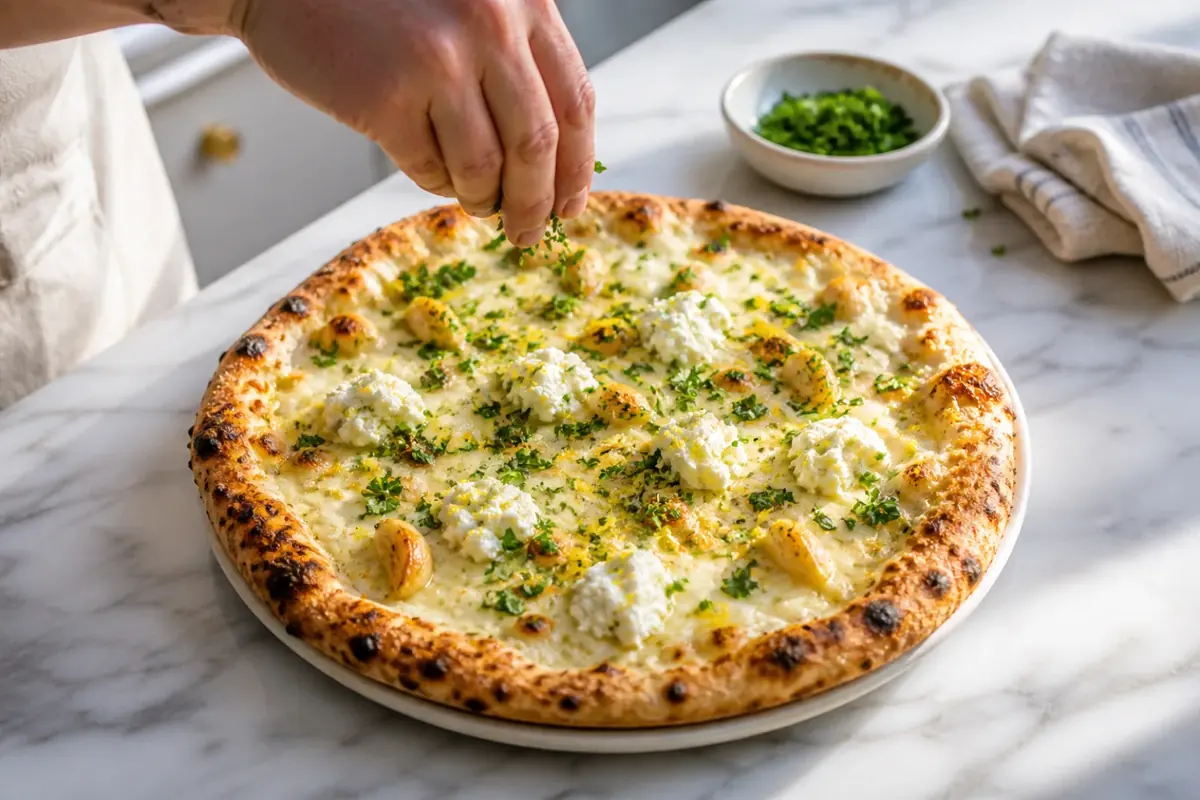
This garlic, herb, and ricotta pizza gets its structure from a simple topping order: low-moisture mozzarella goes down first, seasoned ricotta follows in small dollops, and the most delicate herbs are added after baking. The mozzarella forms a modest barrier between the dough and the wetter ricotta while also spreading the richness across the entire pizza.
Ricotta varies considerably in moisture. A thick, moundable ricotta can be used directly from the container, but a loose or visibly watery one should drain before it reaches the dough. Small dollops also matter. They heat more evenly, distribute the garlic, and leave open spaces where moisture can escape and the mozzarella can brown.
The recipe works on a thoroughly heated baking steel or stone. A metal pizza pan or baking sheet also works, though the crust may need several additional minutes to color underneath. Use the visual doneness cues rather than treating one baking time as universal.
The recipe
Garlic, Herb and Ricotta Pizza
Pizza
- 1 pizza dough ball, about 8 to 9 ounces or 225 to 255 grams, enough for one 12-inch pizza
- 3/4 cup or about 6 ounces whole-milk ricotta
- 1 small garlic clove, finely grated or crushed to a paste
- 1/8 teaspoon fine salt, plus more only if needed
- 1/8 teaspoon freshly ground black pepper, plus more for finishing
- 2 teaspoons extra-virgin olive oil, divided
- 3 ounces low-moisture whole-milk or part-skim mozzarella, shredded
- 1/2 ounce finely grated Parmesan or Pecorino Romano, about 2 tablespoons
- 2 tablespoons chopped tender herbs, such as flat-leaf parsley, basil, chives, or a mixture, divided
- 1/2 teaspoon finely grated lemon zest, optional
For shaping and serving
- Semolina flour, cornmeal, or regular flour for the pizza peel, as needed
- Crushed red pepper flakes, optional
- Extra-virgin olive oil for a light finishing drizzle, optional
Method
- Warm the dough. Take refrigerated pizza dough out 45 to 90 minutes before shaping, keeping it covered so the surface does not dry out. It is ready when it feels flexible and stretches under gentle pressure. Cold dough tends to spring back and can tear around the topping. If the dough has already reached room temperature, begin with the next step.
- Heat the oven and baking surface. Place a baking steel or stone on a rack in the upper-middle or middle of the oven, leaving enough clearance to launch the pizza safely. Heat the oven to its highest normal baking setting, ideally 500 to 550°F. Preheat a steel for at least 45 minutes and a stone for about 60 minutes so the baking surface is hot through, not merely warm on the outside. If using a pizza pan or baking sheet, heat the oven to 475 to 500°F; the pan itself does not need to preheat.
- Drain loose ricotta. Check the ricotta before seasoning it. If liquid has collected around the cheese or it spreads like a thin sauce, spoon it into a fine-mesh strainer set over a bowl and refrigerate for 20 to 30 minutes. For especially loose ricotta, line the strainer with cheesecloth or a clean, lint-free kitchen towel. The finished ricotta should hold a spoon-shaped mound.
- Season the ricotta. Combine the drained ricotta, garlic, salt, black pepper, 1 teaspoon olive oil, 1 tablespoon chopped herbs, and the optional lemon zest. Stir just until evenly mixed. Taste the mixture before adding more salt because the mozzarella and Parmesan will contribute additional saltiness. Keep the ricotta refrigerated if the dough or oven still needs substantial time.
- Shape the crust. Dust a pizza peel lightly with semolina, cornmeal, or flour. On a separate lightly floured surface, press the dough from the center outward, leaving a 1/2-inch rim slightly thicker. Lift and gently stretch it into an approximately 12-inch round. Avoid using a rolling pin if you want a puffier edge. If the dough repeatedly snaps back, cover it and let it rest for 10 to 15 minutes before continuing. Transfer the shaped dough to the prepared peel and shake the peel gently to confirm that the dough moves.
- Add the toppings. Brush or drizzle the remaining 1 teaspoon olive oil over the dough, stopping short of the rim. Scatter the shredded mozzarella in a thin, even layer. Drop the seasoned ricotta over it in teaspoon-size portions, leaving visible gaps between the dollops. Finish with the grated Parmesan or Pecorino. Do not spread the ricotta into a continuous blanket; that traps steam and makes the center slower to bake.
- Launch the pizza. Give the loaded peel another gentle shake. If one area sticks, lift that edge with a bench scraper or spatula and push a small pinch of semolina or flour underneath. Slide the pizza onto the hot steel or stone. If using a pizza pan or sheet pan, assemble the pizza directly on the lightly oiled pan and place it on the middle rack.
- Bake until browned. Bake on a steel for approximately 7 to 9 minutes, on a stone for 8 to 12 minutes, or on a metal pan for 12 to 16 minutes. Rotate the pizza once if the back of the oven browns more quickly. The pizza is done when the rim is expanded and well browned, the underside has firm brown spots rather than a pale, soft center, the mozzarella is bubbling, and the ricotta is hot with lightly colored peaks. If the top colors before the bottom, move the pizza to a lower rack for the final minute or two. If the bottom finishes first, move it to a higher rack.
- Finish and slice. Transfer the pizza to a cooling rack for 1 to 2 minutes so steam does not soften the underside. Move it to a cutting board, scatter over the remaining tablespoon of herbs, and add black pepper, red pepper flakes, or a very light drizzle of olive oil if desired. Cut into six slices and serve while the crust remains crisp.
Equipment
A baking steel gives the fastest bottom browning in many home ovens because metal transfers stored heat efficiently. A pizza stone also produces a well-baked crust but generally benefits from a longer preheat. Either surface should be used according to its manufacturer’s temperature and handling directions.
You will also need a pizza peel or a flat rimless baking sheet for transferring the pizza, a box grater, a small mixing bowl, and a cutting board. A fine-mesh strainer is useful when the ricotta contains visible whey. If you do not own a stone, steel, or peel, assemble the pizza on a lightly oiled metal pizza pan or sheet pan and allow extra baking time.
- Best heat transfer: baking steel
- Good alternative: pizza stone
- Simplest setup: dark metal pizza pan or sheet pan
- Helpful small tools: fine grater, fine-mesh strainer, bench scraper, and pizza wheel
How to keep ricotta pizza from becoming watery
Moisture control starts with the cheese. Whole-milk ricotta gives the pizza a creamy texture, but brands and batches can range from dense to nearly pourable. Drain any ricotta that cannot hold a mound. Pressing it aggressively is unnecessary; gravity should remove free liquid without turning the cheese dry and chalky.
Low-moisture mozzarella is more dependable here than fresh mozzarella packed in liquid. Fresh mozzarella can be substituted, but it should be torn into small pieces, drained on towels, and limited to roughly 3 ounces. Even then, expect softer pools around the cheese.
Keep the ricotta dollops around one teaspoon each. Large scoops may remain relatively cool in the middle while releasing liquid onto the crust. Gaps between the dollops expose more mozzarella to the oven and give steam a route out of the pizza. Avoid adding watery vegetables unless they have been cooked or thoroughly dried first.
- Drain loose ricotta for 20 to 30 minutes.
- Use low-moisture mozzarella for predictable melting.
- Apply ricotta in small, separated dollops.
- Do not overload the center of the dough.
- Let the finished pizza stand on a rack briefly before cutting.
Herb and cheese substitutions
Parsley is sturdy, fresh-tasting, and less likely to dominate the garlic. Basil adds a sweeter aromatic note but darkens quickly in intense heat, so most or all of it should go on after baking. Chives bring a mild onion flavor. Oregano is more concentrated; if using fresh oregano, start with 1 to 2 teaspoons rather than replacing the full quantity of tender herbs.
Pecorino Romano is sharper and generally saltier than Parmesan. Either works, but taste the ricotta mixture before adding extra salt. A small amount of lemon zest brightens the dairy without making the pizza taste lemony. It is optional and should not be replaced with lemon juice, which adds unnecessary liquid.
Part-skim ricotta can replace whole-milk ricotta, although its texture may be a little less rich. For a milder garlic flavor, use half a small clove. Garlic powder also works in a pinch: use about 1/8 teaspoon and let the seasoned ricotta stand for five minutes before tasting. Avoid large pieces of raw garlic, which can remain harsh or scorch on exposed areas.
- For a parsley-forward pizza: use 2 tablespoons chopped flat-leaf parsley.
- For basil: mix 1 teaspoon into the ricotta and add the rest after baking.
- For chives: use 1 to 2 tablespoons, depending on their strength.
- For oregano: use 1 to 2 teaspoons fresh or a small pinch dried.
Using store-bought or homemade dough
A dough ball weighing 8 to 9 ounces is a practical amount for a moderately thin 12-inch pizza. Store-bought dough may be packaged in a larger portion; weigh and divide it if necessary rather than stretching the entire package into an overloaded, thick pizza. Keep unused dough covered and refrigerated according to its label.
Dough that resists shaping usually needs rest, not more force. Cover it for 10 to 15 minutes to let the gluten relax, then resume stretching. A shrinking crust that is forced flat often becomes uneven, with a thin center and a thick outer band.
Raw flour and unbaked pizza dough should not be tasted. Flour is a raw agricultural product and may carry harmful germs until it is cooked. Wash hands, utensils, and work surfaces after handling raw dough or loose flour, and bake the crust completely before eating it. (cdc.gov)
Topping additions that suit this white pizza
This pizza is balanced as written, but a restrained additional topping can change its direction without burying the ricotta. Thinly sliced mushrooms should be sautéed first so they do not release their water over the cheese. Spinach should be wilted, cooled, and squeezed dry. Roasted red peppers and jarred artichokes should be drained and blotted before use.
For a salty accent, add a small amount of finely chopped olive or a few pieces of thinly sliced cured meat. Check whether the added ingredient is already salty before seasoning the ricotta. Limit additions to roughly 1/2 cup in total so the dough can still bake quickly and the center remains supported.
Arugula makes a peppery after-baking garnish. Dress it lightly, if at all, and add it only after the pizza leaves the oven. A heavy salad topping can trap steam against the crust and make slices difficult to handle.
- Sautéed mushrooms: up to 1/2 cup
- Wilted and squeezed spinach: up to 1/3 cup
- Drained artichoke hearts: up to 1/3 cup
- Roasted red pepper strips: up to 1/3 cup
- Arugula: one loose handful, added after baking
Storage and reheating
Refrigerate leftover pizza within two hours of baking, or within one hour when the surrounding temperature is above 90°F. Store slices in a shallow airtight container or wrap them closely, and keep the refrigerator at 40°F or below. USDA guidance gives a general refrigerated storage window of 3 to 4 days for leftovers. (fsis.usda.gov)
For the crispest reheating, place slices in a dry skillet over medium-low heat. Cover for 2 to 3 minutes to warm the cheese, then uncover and continue for another 1 to 3 minutes until the base is crisp. Watch the underside because a thin crust can darken quickly.
An oven or toaster oven is better for several slices. Heat to 375°F and place the pizza directly on a rack or on a preheated sheet pan for about 5 to 8 minutes. The cheese should be hot and the crust firm. A microwave will warm the pizza but tends to soften the base; use short intervals and avoid overheating the ricotta.
To freeze, cool the pizza promptly, place parchment or freezer paper between slices, and seal them in a freezer-safe container. Thaw overnight in the refrigerator or reheat from frozen at 375°F, allowing roughly 10 to 15 minutes. Time will vary with crust thickness and the number of slices.
Troubleshooting
A pale underside usually means the baking surface was not heated long enough, the oven temperature was too low, or the pizza was placed too high in the oven. Extend the preheat and move the stone or steel one rack lower next time. On a sheet pan, a dark metal pan generally browns more effectively than a shiny insulated one.
If the center is wet, inspect the ricotta and any added vegetables. Drain loose cheese, dry vegetables, use smaller dollops, and leave more open space between toppings. Excess flour under the pizza can also form a dusty, pale layer rather than a crisp crust, so use only enough to prevent sticking.
If the rim is dense, the dough may have been too cold, overworked, or pressed flat at the edge. Allow the dough to warm until flexible, handle it gently, and preserve a narrow raised border while shaping. If it tears, pinch the opening closed and avoid placing a ricotta dollop directly over the repair.
If the pizza sticks to the peel, it may have sat too long after shaping or may contain a wet spot. Work efficiently once the dough reaches the peel, check for movement before and after topping, and free stuck areas before approaching the hot oven. Never jerk a firmly stuck pizza toward an exposed hot surface.
Recipe questions
Questions about this recipe
Can I spread the ricotta over the entire pizza?
You can, but a continuous ricotta layer holds more moisture against the dough and reduces mozzarella browning. Teaspoon-size dollops give each slice creamy pockets while leaving room for steam to escape.
Should ricotta go above or below the mozzarella?
Put the mozzarella down first for this recipe. It spreads evenly and creates a modest buffer between the dough and the wetter ricotta. The exposed ricotta dollops can then heat and color at their edges.
Can I use fresh mozzarella?
Yes, but drain it thoroughly, tear it into small pieces, blot it with clean towels, and use no more than about 3 ounces. Because fresh mozzarella contains more water than low-moisture mozzarella, the pizza may have softer areas around the cheese.
Can I make the ricotta mixture ahead?
Yes. Mix it, cover it, and refrigerate it for up to one day. Stir before using and drain off any liquid that collects. Keep the mixture cold until you are ready to top the pizza.
Why is my pizza dough springing back?
The dough is probably cold or its gluten is tight from recent handling. Cover it and rest it for 10 to 15 minutes, then continue stretching gently. Repeated force usually makes the problem worse.
Does this pizza need tomato sauce?
No. This is a white pizza, meaning it is assembled without tomato sauce. Olive oil, mozzarella, seasoned ricotta, and grated hard cheese provide the base, while garlic and herbs supply the main aromatic flavors.
Sources and further reading