Pizza Informer recipe
Deep-Dish Pizza in a 10-Inch Pan
Published December 31, 2022Last updated August 7, 2026
A complete home deep-dish pizza recipe with a sturdy cornmeal dough, thick tomato sauce, layered cheese, optional cooked toppings, and clear cues for a browned—not gummy—crust.
Jump to recipe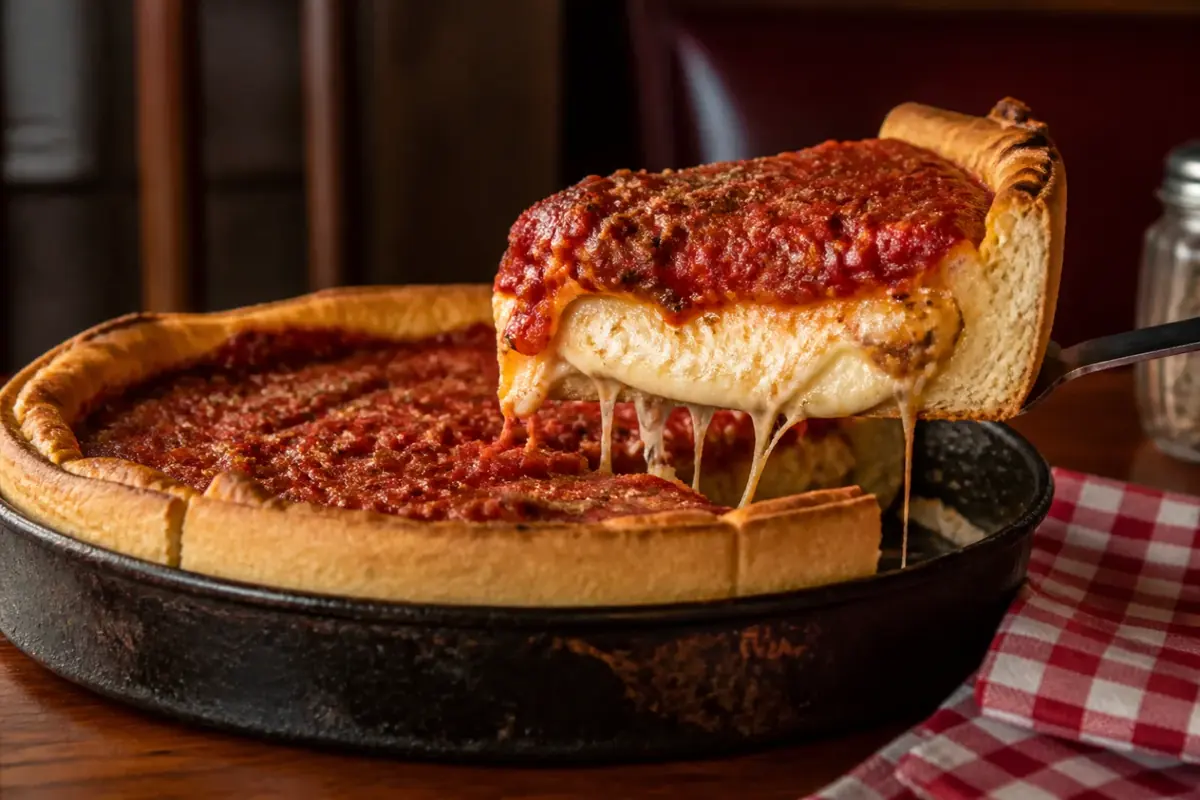
This recipe makes one substantial deep-dish pizza in a 10-inch cast-iron skillet or a 10-inch round metal pan at least 2 inches deep. The dough is pressed across the base and up the sides, briefly baked to set its shape, then filled in deep-dish order: mozzarella first, prepared toppings second, and thick tomato sauce on top.
The short initial bake helps a home oven cook the bottom crust before the moist filling goes in. It is especially useful with a heavy cast-iron skillet or a generous layer of sauce. Rest the finished pizza for at least 10 minutes before cutting; an immediate slice is likely to release molten cheese and sauce across the board.
The recipe
Deep-Dish Pizza in a 10-Inch Pan
Deep-dish dough
- 2 cups plus 2 tablespoons (255 grams) all-purpose flour, plus more only if needed
- 1/4 cup (35 grams) fine or medium yellow cornmeal
- 1 teaspoon (4 grams) instant yeast
- 1 teaspoon (6 grams) fine salt
- 3/4 cup plus 1 tablespoon (195 grams) lukewarm water
- 2 tablespoons (28 grams) olive oil
- 1 tablespoon (14 grams) unsalted butter, melted and cooled slightly
Thick tomato sauce
- 1 can (14 ounces or 400 grams) crushed tomatoes
- 2 tablespoons tomato paste
- 1 teaspoon dried oregano
- 1/2 teaspoon garlic powder, or 1 small garlic clove finely grated
- 1/4 teaspoon fine salt, plus more to taste
- 1/4 teaspoon ground black pepper
- Pinch of red pepper flakes, optional
- 1 teaspoon olive oil
Filling and pan
- 1 tablespoon olive oil, for the pan
- 8 ounces (225 grams) sliced low-moisture whole-milk mozzarella
- Up to 6 ounces (170 grams) fully cooked, well-drained toppings, such as crumbled Italian sausage, sautéed mushrooms, or roasted peppers
- 1 ounce (28 grams) finely grated Parmesan
- 1 teaspoon olive oil, for the top, optional
Method
- 1. Mix the dough. Combine the all-purpose flour, cornmeal, instant yeast, and salt in a large bowl. Add the lukewarm water, 2 tablespoons olive oil, and melted butter. Stir until no dry flour remains. Knead by hand on a lightly floured counter for 6 to 8 minutes, or mix with a dough hook on low speed for about 5 minutes. The finished dough should be smooth, supple, and slightly tacky but should not leave wet smears on your hands. If it is very sticky after two minutes of kneading, add flour 1 teaspoon at a time rather than adding a large handful.
- 2. Let the dough rise. Shape the dough into a ball and place it in a lightly oiled bowl. Cover the bowl and let the dough rise at room temperature for 60 to 90 minutes. It should look puffy and expand to roughly 1 1/2 to 2 times its original size. A cool kitchen may require additional time; judge the dough by its expansion rather than the clock alone.
- 3. Cook and cool the sauce. While the dough rises, combine the crushed tomatoes, tomato paste, oregano, garlic, salt, black pepper, optional red pepper flakes, and 1 teaspoon olive oil in a small saucepan. Bring to a gentle simmer over medium-low heat. Cook uncovered for 12 to 18 minutes, stirring regularly, until the sauce is thick enough to mound briefly on a spoon instead of running like tomato juice. Remove it from the heat and let it cool. Hot sauce can soften the unbaked dough and make assembly harder.
- 4. Prepare the pan and oven. Place a rack in the lower third of the oven and heat the oven to 425°F (220°C). Allow at least 30 minutes for a conventional oven and a heavy skillet to heat evenly. Coat the bottom and sides of a 10-inch cast-iron skillet or 10-by-2-inch round metal pan with 1 tablespoon olive oil. Use a pan that is rated for this temperature. Avoid a shallow pizza pan because it cannot contain the filling.
- 5. Press the dough into the pan. Turn the risen dough into the oiled pan and flatten it gently from the center toward the edge. Press the dough about 1 1/2 inches up the sides without creating paper-thin spots. If it repeatedly springs back, cover it and wait 10 minutes so the gluten can relax, then continue. Prick the dough across the bottom six to eight times with a fork, leaving the raised sides intact.
- 6. Set the crust. Bake the empty crust on the lower rack for 7 to 9 minutes. It should lose its raw shine, feel set when lightly touched, and show only the first hint of color. Large bubbles can be pressed down carefully with the back of a spoon. Do not bake until deeply browned at this stage because the crust still needs another 25 minutes or more in the oven.
- 7. Layer the filling. Arrange the sliced mozzarella across the warm crust, overlapping pieces as needed to cover the bottom. Scatter up to 6 ounces of fully cooked, well-drained toppings over the cheese. Spoon the cooled tomato sauce over the toppings and spread it nearly to the edge, leaving the raised rim exposed. Sprinkle with Parmesan and drizzle with the optional teaspoon of olive oil. Keep the filling below the top of the crust so bubbling sauce is less likely to spill into the oven.
- 8. Bake until browned and bubbling. Return the pizza to the lower rack and bake at 425°F (220°C) for 24 to 30 minutes. Rotate the pan after about 18 minutes if your oven browns unevenly. The pizza is ready when the sauce bubbles across the center, the exposed crust is deep golden brown, and the crust has pulled slightly from the side of the pan. Lift an edge carefully with a thin spatula: the underside should be browned and firm, not pale, soft, or gummy. For a pizza containing meat, check the center with an instant-read thermometer and heat it to 165°F (74°C). If the rim darkens before the center is hot, shield only the rim loosely with strips of foil.
- 9. Rest, release, and slice. Move the hot pan to a stable heatproof surface and rest the pizza for 10 to 15 minutes. Run a thin spatula around the edge to loosen any cheese or sauce. If the base releases cleanly, slide the whole pizza onto a cutting board; otherwise, cut it carefully in the pan with a utensil that will not damage the cooking surface. A serrated knife works well through the tall crust, followed by a pie server or firm spatula to lift each slice.
Equipment that works
A 10-inch cast-iron skillet produces a well-browned base and holds heat effectively, but it is heavy and remains dangerously hot long after baking. A light-colored aluminum cake or deep-dish pizza pan heats faster and may produce a slightly softer bottom. Either pan should have sides at least 2 inches high.
A digital scale makes the dough easier to repeat because flour can pack tightly into a measuring cup. You will also need a mixing bowl, saucepan, wooden spoon or dough hook, thin spatula, oven mitts, and a cooling rack or heatproof trivet. An instant-read thermometer is useful when the filling includes meat.
- Do not place a hot glass pan on a wet or cold surface; sudden temperature changes can break some glass bakeware.
- A springform pan can leak oil or sauce through its seam. If it is your only option, place it on a rimmed sheet pan and verify that the manufacturer rates it for 425°F.
- Set the deep pan on a sheet pan if the filling comes close to the rim, but expect the extra layer of metal to slow browning underneath.
Topping substitutions and moisture control
Deep-dish pizza can hold more filling than a thin pizza, but excess moisture still creates a gummy center. Cook raw meat before assembly, sauté mushrooms until their released liquid evaporates, drain roasted peppers, and squeeze thawed spinach thoroughly. Let hot toppings cool before placing them over the cheese.
Use no more than about 6 ounces of prepared toppings for this 10-inch pizza. A larger pile extends the baking time and can trap steam. Pepperoni may be used without precooking, although blotting surface oil during baking can keep the sauce from becoming greasy. For a cheese pizza, omit the toppings and add another 2 ounces of mozzarella if desired.
- Provolone can replace up to half of the mozzarella for a sharper flavor and a slightly firmer melt.
- Part-skim low-moisture mozzarella works, but it generally melts less richly than whole-milk mozzarella.
- Fresh mozzarella contains substantially more water. If using it, drain and blot it thoroughly, use no more than 6 ounces, and expect a softer filling.
- For a vegetarian pizza, use sautéed mushrooms, cooked spinach, roasted peppers, or drained artichoke hearts in any combination totaling no more than 6 ounces.
Make-ahead options
For a longer fermentation, mix the dough with 1/2 teaspoon instant yeast instead of 1 teaspoon. Cover and refrigerate it for 12 to 24 hours. Remove it from the refrigerator 60 to 90 minutes before shaping so it can lose its chill and become flexible. Cold dough that snaps back should be given another 15 minutes at room temperature.
The sauce can be prepared up to three days ahead and refrigerated in a covered container. Cooked toppings can also be prepared in advance, but keep each component chilled separately. Assemble the pizza shortly before baking; storing the filled, unbaked pizza gives the sauce time to soak into the crust.
- Freeze unused thick sauce in a sealed container with room for expansion.
- Do not put a refrigerator-cold cast-iron skillet directly into a fully heated oven if the skillet contains chilled ingredients; let the assembled pan stand briefly while the oven finishes heating.
- A fully baked pizza freezes more successfully than an assembled raw pizza.
Storage and reheating
Refrigerate leftover pizza within two hours of cooking. Cut it into individual portions and place them in shallow, covered containers so they cool efficiently. USDA guidance says refrigerated leftovers are generally kept for three to four days; freeze portions if they will not be eaten in that period. (fsis.usda.gov)
For the crispest reheating, place a slice in a lightly covered skillet over medium-low heat for 3 to 5 minutes, then add a few drops of water beside—not on—the crust and cover for another 2 to 4 minutes. The steam heats the dense filling while the skillet firms the bottom. You can also reheat slices on a sheet pan in a 375°F (190°C) oven for 12 to 18 minutes. USDA guidance calls for leftovers to reach 165°F (74°C) when reheated. (fsis.usda.gov)
To freeze, chill the pizza first, wrap individual slices securely, and place them in a freezer container. Thaw overnight in the refrigerator or reheat from frozen in a 350°F (175°C) oven. Frozen slices may need 20 to 30 minutes, depending on thickness. Cover loosely for the first half of reheating if the exposed crust begins to darken before the center is hot.
- A microwave heats the filling quickly but softens the crust. Use medium power, rotate the slice, allow a brief standing time, and verify that the center is hot.
- Do not leave the pizza in its cast-iron pan for refrigerator storage; prolonged contact with acidic tomato sauce can affect the pan’s seasoning.
- Discard perishable pizza left at room temperature for more than two hours, or more than one hour when the surrounding temperature is above 90°F (32°C).
Troubleshooting deep-dish pizza
A pale or gummy bottom usually means the pan was too high in the oven, the sauce was watery, the toppings released moisture, or the pizza was removed before the base browned. Use the lower rack, reduce the sauce until thick, precook wet toppings, and inspect the underside before taking the pizza out.
If the crust is tough, too much flour may have been added during kneading, or the dough may have been pressed excessively thin at the bottom. A scale helps prevent an overly dry dough. If the rim is dense rather than airy, let the first rise continue until the dough is visibly puffy.
If the pizza sticks, loosen it after the resting period with a thin metal spatula, working gradually around the edge. Burned cheese between the crust and pan can act like glue. On the next pizza, keep cheese inside the dough wall and coat the pan evenly rather than leaving dry patches.
- Sauce pools on top: simmer it longer before assembly and drain watery toppings more thoroughly.
- Dough tears while shaping: pinch small holes closed and let the dough rest for 10 minutes before continuing.
- Crust browns too quickly: shield the rim with foil and continue baking until the center bubbles and the bottom is cooked.
- Filling spills when sliced: allow a full 15-minute rest and use less sauce or fewer toppings next time.
- Bottom remains soft after the top is done: remove the pizza from the pan and place it directly on the oven rack for 2 to 4 minutes, watching closely.
How this differs from other pan pizzas
This is a home deep-dish method rather than a general thick-crust pan pizza. Its raised dough wall contains distinct layers, and the tomato sauce goes above the cheese and toppings. That arrangement protects the cheese during the relatively long bake and keeps it from becoming excessively browned before the crust cooks.
Detroit-style pizza is usually baked in a rectangular metal pan with cheese pushed to the edges, where it forms a dark, crisp border. Stuffed pizza uses an additional sheet of dough over the filling before the sauce is added. Those styles require different dough quantities, pans, and baking methods; they are not simple shape variations of this recipe.
Some published deep-dish formulas use a larger pan, more fat, or no initial crust bake. The brief set used here is a practical choice for a 10-inch home-oven pizza with a thick filling. King Arthur Baking’s larger Chicago-style recipe also emphasizes layered cheese, prepared filling, drained tomatoes, a hot oven, and a resting period before slicing. (kingarthurbaking.com)
Recipe questions
Questions about this recipe
Can I use store-bought pizza dough?
Yes, but choose about 18 to 20 ounces of dough and let refrigerated dough warm at room temperature until flexible. Store-bought dough may be leaner than this cornmeal-and-butter dough, so the crust can be chewier and may spring back more during shaping. Keep the same pan size, par-bake cues, filling limits, and final doneness checks.
Can I make this without cornmeal?
Yes. Replace the 35 grams of cornmeal with 35 grams of all-purpose flour. The dough will have a smoother texture and less corn flavor, but the hydration remains workable. Do not scatter loose cornmeal under the dough in an oiled pan because it can form hard patches or burn.
Why does the cheese go under the sauce?
The lower cheese layer separates the dough from some of the sauce’s moisture. It also protects the mozzarella from the full duration of the bake. Keep the sauce thick and the toppings well drained; the layering order cannot compensate for watery ingredients.
Can I double the recipe for a larger pan?
Do not automatically double it. Pan area changes with the square of the diameter: a 12-inch round pan has about 44 percent more surface area than a 10-inch pan, not twice as much. Multiply each ingredient by roughly 1.4 for a 12-inch pan and begin checking the bake at the same time, allowing extra minutes if the center is not hot.
Can the pizza be removed from the pan before slicing?
Usually, provided the pan was evenly oiled and the bottom is fully baked. Rest it first, loosen the entire edge, and slide a wide spatula underneath. If the pizza resists or bends heavily in the center, slice it in the pan with a utensil that will not scratch the surface.
Sources and further reading